
Have you ever looked at your NDIS plan and wondered if "improving health" actually translates to real-world clinical support? It's a common frustration to feel like you're stuck in a maze of jargon while trying to figure out if your ndis exercise physiology coverage is actually there to help you move better. You might worry that exercise sounds too much like a lifestyle choice to be considered "reasonable and necessary," but clinical movement is actually a fundamental, evidence-based tool. It's designed to bridge the gap between your current physical challenges and the independence you're working toward.
We know that the referral pathways can feel overwhelming and the fear of "getting it wrong" is real. This guide will give you total clarity on how Exercise Physiology fits into your Capacity Building (support that builds your skills) budget. We'll explain the latest 2026 pricing arrangements, confirm exactly what's funded, and show you how to start your therapy journey at a local clinic like MoveMed without the administrative headache.
Key Takeaways
- Learn why the NDIS views movement as a clinical investment in your independence and how to ensure your therapy meets the "reasonable and necessary" funding criteria.
- Understand the specific clinical differences between Physiotherapy and Exercise Physiology so you can choose the right specialist for your long-term functional goals.
- Discover exactly where to find your ndis exercise physiology coverage within your plan's 'Capacity Building' budget categories.
- Get a clear roadmap for starting therapy at a local clinic that manages the NDIS administrative burden so you can focus on your health and movement.
Understanding the NDIS: Meaning and Purpose for Allied Health
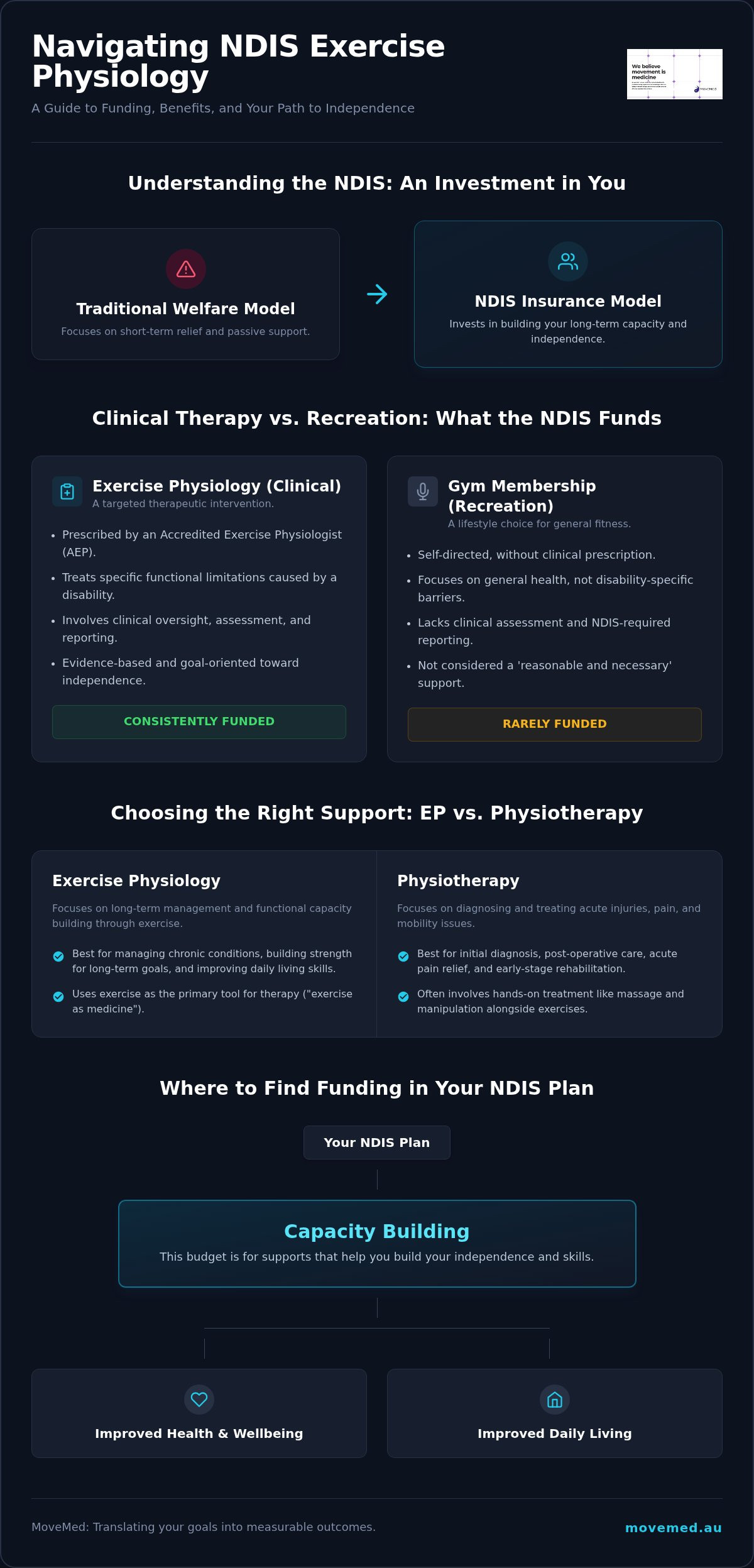
What does the NDIS actually mean for your Tuesday morning? Beyond the paperwork, the National Disability Insurance Scheme is Australia's way of ensuring that people with a permanent and significant disability have the resources they need to participate in the community. It's helpful to think of it as a shift from a welfare model to an insurance model. While welfare often focuses on short-term relief, the NDIS acts as an investment. By funding clinical supports like Exercise Physiology today, the scheme aims to build your physical capacity. This reduces your reliance on other supports in the future.
For a service to be funded, it must be deemed "reasonable and necessary." In the context of movement, this means your ndis exercise physiology coverage isn't just about "getting fit." It's about specific, clinical interventions that help you achieve your goals. This might look like being able to walk to the shops independently or managing the chronic fatigue associated with a neurological condition. If the therapy is evidence-based and directly helps you overcome a barrier caused by your disability, it likely fits the criteria. This clinical bridge is designed to help you engage more fully in social and economic life.
The Core Pillars of the NDIS
The scheme is built on three main ideas. First is choice and control; you have the right to decide who provides your therapy and how it's delivered. Second is individualised planning, which ensures your funding is tied to your specific aspirations rather than a generic diagnosis. Finally, there is the lifetime approach. This perspective views health as a long-term asset. Investing in movement now creates a foundation for better health outcomes and greater independence for years to come.
Why MoveMed Focuses on NDIS Goals
At MoveMed, we don't just see a clinical diagnosis; we see a person with a "Statement of Goals and Aspirations." Our Accredited Exercise Physiologists (AEPs) specialise in translating these broad goals into measurable outcomes. Whether your plan mentions "improved daily living" or "health and wellbeing," we use targeted gym or hydrotherapy sessions to track your progress. We understand that the transition to the NDIS can feel like learning a new language. Our role is to act as your translator and guide. Working with an AEP ensures your therapy remains NDIS compliant, as our university-qualified experts provide the clinical reporting required to justify your ongoing ndis exercise physiology coverage.
How Exercise Physiology Fits the NDIS 'Reasonable and Necessary' Criteria
The NDIS doesn't fund supports just because they are helpful. Every item in your plan must meet six specific criteria to be considered "reasonable and necessary." These include ensuring the support is related to your disability, represents value for money, and is likely to be effective. Because Exercise Physiology is an evidence-based clinical practice, it consistently meets these high standards. The NDIA values this support because it focuses on functional outcomes that lead to real-world independence.
A common point of confusion is the difference between "clinical therapy" and "general recreation." You might wonder why the NDIS funds Exercise Physiology but rarely pays for a standard gym membership. The distinction lies in the clinical oversight. A gym membership is a lifestyle choice; Exercise Physiology is a clinical intervention. An Accredited Exercise Physiologist (AEP) assesses your specific physical barriers and prescribes movement to treat the functional limitations caused by your disability. This clinical rigour is vital for maintaining your ndis exercise physiology coverage during plan reviews.
From an insurance perspective, Exercise Physiology is a high-value investment. By improving your strength, balance, and coordination, you often reduce the need for more expensive 1:1 personal care or emergency medical interventions. It's about building your capacity to do more for yourself, which aligns perfectly with the scheme's goal of social and economic participation.
Capacity Building: The Home of Exercise Physiology
Most participants find their funding for movement within the Capacity Building budget. This usually falls under the "Improved Health and Wellbeing" or "Improved Daily Living" categories. These funds are specifically designed to help you learn new skills and increase your daily independence. At MoveMed, we use these categories to provide specialised care, including Clinical Reformer Pilates or Hydrotherapy. These aren't just exercise classes. They are therapeutic sessions led by an expert who understands your clinical history. If you're unsure where your funding sits, our team can help you review your plan to find the right path forward.
Addressing the 'Disability-Related' Requirement
To be funded, a support must directly address the functional impacts of your disability. Exercise Physiology is uniquely positioned to manage complex symptoms like muscle spasticity, chronic pain, or reduced mobility. Beyond immediate symptom management, clinical movement plays a critical role in preventing secondary health complications, such as cardiovascular disease, which often disproportionately affect people with permanent disabilities. Whether managing the sensory processing needs of neurodivergent clients or the physical rehabilitation of those with mobility impairments, Exercise Physiology provides a tailored clinical framework for progress. This dual focus on current function and long-term resilience is why EP is such a cornerstone of effective ndis exercise physiology coverage.
Comparing NDIS Exercise Physiology and Physiotherapy: Choosing the Right Support
Choosing between Physiotherapy and Exercise Physiology often feels like a coin toss when you're filling out your NDIS goals. While both are allied health professions, they serve very different roles in your recovery journey. Physiotherapy is usually the first port of call for acute injuries or a new diagnosis. They focus on diagnosis and "hands-on" treatment like joint mobilisation, massage, or dry needling. It's the "fix it" phase of your care. If you've recently had a surgery or a sudden flare-up of pain, a physiotherapist is your primary ally for reducing inflammation and restoring basic movement.
To see how specialised clinical care addresses complex recovery, you can learn more about Fruitland Physiotherapy and their evidence-based approach to managing chronic pain.
In contrast, an Exercise Physiologist (AEP) focuses on the "hands-off" clinical management of your condition through movement. We don't just treat the immediate pain; we build the physical capacity you need to live your life. When deciding how to allocate your budget, understanding the nuances of ndis exercise physiology coverage compared to physiotherapy is essential for long-term success. For complex participants, such as those living with multiple sclerosis or a spinal cord injury, the best results often come from a multidisciplinary approach. The physio manages the acute mobility issues, while the EP builds the strength and stamina required for daily independence.
At MoveMed, our EPs in Templestowe Lower don't work in a vacuum. We actively collaborate with your wider healthcare team, including your GP and physiotherapist. This ensures your exercise program supports your clinical diagnosis without causing setbacks. We act as the bridge between your initial recovery and your long-term functional goals.
Key Differences in Therapy Delivery
The main difference lies in the shift from acute recovery to lifestyle modification. While a physiotherapist might work on a specific joint, an EP uses "Exercise Prescription" to treat the whole person. This prescription is a detailed clinical plan that outlines exactly how movement will improve your disability symptoms. This evidence-based reporting is a key feature of ndis exercise physiology coverage, providing the NDIA with clear proof of your progress. Because the focus is on building skills and habits, EPs are often the preferred choice for goals found in the "Capacity Building" section of your plan.
Which One Should You Put in Your Plan?
Start by assessing your primary goal. Are you trying to fix a specific injury, or are you trying to build a lifestyle that accommodates your disability? If it's the latter, Exercise Physiology is likely your best fit. NDIS funding is often flexible, but you should always consult with your Local Area Coordinator (LAC) or Support Coordinator before making a switch. They can help you determine if your current funding categories, like "Improved Daily Living," allow for the specific clinical support you need. If you're based in the Doncaster or Templestowe area, we can sit down with you to review your plan and help you understand how to best utilise your allocated funds.
Navigating Your NDIS Plan: How to Access Exercise Physiology Funding
Getting started with clinical movement shouldn't feel like a second job. Once you've identified that you want to improve your functional independence, the process of activating your ndis exercise physiology coverage follows a structured path. This roadmap is designed to ensure you receive the right care while meeting all the compliance requirements set by the NDIA. We've broken this down into five clear steps to help you move from planning to action.
- Step 1: Confirm your funding. Open your NDIS plan and look for the 'Capacity Building' budget. You'll typically find your funding under 'Improved Health and Wellbeing' or 'Improved Daily Living'.
- Step 2: Connect with a local provider. For residents in Templestowe Lower or Doncaster, finding a clinic that understands our local community makes a difference. You want a team that can handle the clinical side while you focus on your goals.
- Step 3: Attend an Initial Assessment. This is where we set your clinical baselines. It's a vital session that provides the evidence needed to justify your support.
- Step 4: Sign a Service Agreement. This document protects your rights. It outlines the frequency of your sessions, how your funding is managed, and our commitment to your care.
- Step 5: Ongoing reporting. As your plan review approaches, your Exercise Physiologist will write a progress report. This document proves the value of your therapy and helps secure your funding for the next cycle.
The Role of the Initial Assessment
Your journey begins with a deep dive into your current physical capacity. We don't just guess; we use standardised clinical tests to measure things like balance, strength, and mobility. These results are then directly linked to the goals in your NDIS plan. By the end of this session, you'll have a personalised 12-month Management Plan. This document acts as your clinical North Star, ensuring every session at the clinic or pool is a step toward greater independence. If you're ready to set your baselines, you can book an initial assessment with our team today.
Managing Your Funding: Self-Managed vs. Plan-Managed
How you manage your plan determines how we handle the paperwork. If you're self-managed, you have the most flexibility; you pay for your sessions and then claim the funds back through the NDIS portal. For plan-managed participants, we send our invoices directly to your plan manager. This is a popular choice for many Templestowe residents as it removes the administrative burden entirely. If you're currently in a plan that doesn't explicitly mention ndis exercise physiology coverage, don't lose heart; we can help you gather the clinical evidence needed to request a plan variation or prepare for your next scheduled review. If you need to keep your home office organised for these records, you can learn more about Mega Office Supplies for all your filing essentials. We're here to act as your advocate, ensuring you have access to the high-quality care you deserve.
MoveMed: Your Local NDIS Exercise Physiology Partners in Templestowe Lower
We are more than just a clinic; we are your neighbours. Based in the heart of Templestowe Lower, MoveMed is deeply committed to supporting the health and independence of participants across the Doncaster, Bulleen, and Templestowe communities. We understand that the local landscape matters. Whether you're navigating the hills of the eastern suburbs or looking for a clinical space that feels like home, our team is here to act as your local ally. Our Accredited Exercise Physiologists (AEPs) are specialists in disability care, focusing on the "Capacity Building" goals that allow you to reclaim your confidence and movement.
Our approach to ndis exercise physiology coverage is built on transparency and clinical excellence. We don't believe in one-size-fits-all solutions. Instead, we partner with you to understand your unique challenges, whether you're managing a lifelong condition or a recent change in your mobility. We handle the clinical reporting and administrative requirements so you can focus on the physical work of getting better. By providing clear, evidence-based data to the NDIA, we help ensure your support remains a consistent part of your long-term health investment.
Tailored Programs for Local Participants
Movement looks different for everyone. That's why we offer a variety of clinical environments to suit your needs. We utilise local facilities for hydrotherapy (aquatic therapy), which is an excellent low-impact option for those with joint pain or mobility restrictions. In the clinic, we offer Clinical Reformer Pilates. This is a unique, NDIS-friendly movement option that focuses on core stability, balance, and controlled strength. These programs are designed not just for short-term relief, but for long-term physical well-being. We want to see you moving better in your own home, at the shops, and within our local parks.
Get Started with MoveMed Today
Starting your journey with us is a straightforward, low-friction process. We accept referrals from GPs, Support Coordinators, and Local Area Coordinators, but you can also reach out to us directly to begin the conversation. When you come for your first NDIS appointment at our clinic, please bring a copy of your current plan, your list of goals, and any relevant medical history. This allows us to hit the ground running and maximise your ndis exercise physiology coverage from day one. You'll join a community that celebrates every milestone, no matter how small. Every step toward independence is a victory we share together.
Book your NDIS Exercise Physiology assessment at MoveMed Templestowe Lower and take the first step toward a more mobile, independent future.
Taking the Next Step Toward Functional Independence
We've explored how clinical movement serves as a powerful bridge between your current challenges and your long-term independence goals. By understanding how to navigate your ndis exercise physiology coverage, you can ensure your funding is used for evidence-based care that truly builds your capacity. Whether you're choosing between different allied health supports or setting your clinical baselines, the focus should always remain on your unique functional aspirations. You deserve a plan that works as hard as you do.
MoveMed is proud to be a team of NDIS Registered Allied Health Professionals serving the Templestowe, Doncaster, and Bulleen communities. We provide the evidence-based clinical care and administrative support you need to make the most of your plan. You don't have to manage the complex paperwork or clinical reporting alone. Our experts are here to handle the details so you can focus on moving better and feeling more confident in your daily life.
Start your NDIS journey with a MoveMed Exercise Physiologist
Your path toward a more active and independent life starts with a single, supported step. We look forward to partnering with you on this journey and celebrating every milestone along the way.
Frequently Asked Questions
Does the NDIS cover exercise physiology for mental health conditions?
Yes, the NDIS often funds exercise physiology to support participants with psychosocial disabilities or mental health conditions. Clinical movement is a powerful tool for self-regulation, improving sleep quality, and managing the metabolic side effects of certain medications. If your condition is permanent and significant, and movement helps you engage with your community, it likely meets the funding criteria.
How many hours of exercise physiology can I get in my NDIS plan?
There isn't a fixed number of hours because every plan is individualised. A typical annual allocation might range from 12 to 40 hours; however, this depends entirely on your specific goals and functional needs. We work with you to provide the clinical evidence required to justify the amount of support you need for your ndis exercise physiology coverage to be effective.
Do I need a GP referral to see an NDIS Exercise Physiologist at MoveMed?
You don't strictly need a GP referral to begin sessions at our clinic. While clinical notes from your doctor are always helpful for understanding your medical history, you can self-refer or be referred by your Support Coordinator. We'll handle the initial assessment and set your clinical baselines to get your program started safely.
Can I use my NDIS funding for hydrotherapy sessions?
Yes, you can use your funding for hydrotherapy if it's delivered as a clinical service by an Accredited Exercise Physiologist. We provide hydrotherapy sessions that focus on using the properties of water to improve your mobility and reduce pain. This is a common and effective use of your Capacity Building budget for those with physical disabilities.
What is the difference between an Exercise Physiologist and a Personal Trainer under the NDIS?
The difference lies in clinical qualification and scope of practice. Exercise Physiologists are university-qualified allied health professionals (AEPs) who specialise in treating clinical conditions and disabilities. Personal trainers provide general fitness for the healthy population and don't have the clinical training required to manage complex ndis exercise physiology coverage or provide the necessary reporting for plan reviews.
Will an Exercise Physiologist provide a report for my NDIS plan review?
Providing a detailed progress report is a core part of our clinical service. We track your functional improvements against your initial baselines to show the NDIA exactly how your therapy is helping you achieve your goals. These reports are essential for ensuring your funding is renewed for your next plan cycle.
Can I use my 'Improved Daily Living' budget for Exercise Physiology?
Yes, 'Improved Daily Living' is one of the most common funding categories used for our services. This budget is designed for therapy that builds your capacity for independence in everyday tasks. Because our programs focus on functional movement and self-management, they align perfectly with the requirements of this support category.
What happens if I run out of NDIS funding before my plan ends?
If your funds are exhausted before your review date, you should contact your Support Coordinator or Local Area Coordinator immediately. You may be able to request a plan variation if your circumstances have changed or if your initial allocation was insufficient for your clinical needs. We can provide the supporting data to help you advocate for the necessary funding increase.


